
A water heater that pops, crackles or rumbles sounds alarming, like something’s about to break. Most of the time it isn’t dangerous. It’s a sign your tank needs some attention.
Henley’s says (quick answer): A popping or rumbling water heater is almost always sediment. Minerals from hard water settle on the bottom of the tank, and water trapped under that layer boils and pops when the burner or element heats it. It isn’t an emergency by itself, but it wastes energy and wears the tank out faster. A flush often helps, and an older tank that pops and leaks is usually ready to replace.
En resumen: Un calentador que hace ruidos de “pop” casi siempre tiene sedimento en el fondo del tanque. No suele ser una emergencia, pero conviene limpiarlo o revisarlo.
What it usually means
- Sediment on the bottom (most common). The Inland Empire and much of Orange County have hard water. Calcium and magnesium settle in the tank over time, and steam bubbles push up through the layer and pop.
- Crackling or sizzling on an electric heater. Scale is building up on the heating element.
- Hissing near the top or side. Check the temperature-and-pressure (T&P) relief valve and its discharge pipe for water. A T&P valve releasing water is a warning sign, not a noise to ignore.
- Ticking. Pipes expanding and contracting as hot water flows. Usually harmless.
How it works: a tank heater keeps 30–80 gallons of water hot all day and night. Every gallon brings in a little mineral, and over the years that becomes a crust on the bottom, between the flame or element and the water.
Is it safe to wait?
Usually, yes, for a little while. Popping from sediment isn’t a safety emergency. But waiting has a cost: sediment makes the heater work harder, raises your gas or electric bill, and overheats the tank bottom, which shortens its life. A heater that pops and leaks, makes rusty water, or has water at the T&P valve shouldn’t wait.
Checklist: what’s safe to check yourself
- Check the temperature setting. About 120°F is a common, safe setting. Hotter settings speed up scale and raise scald risk.
- Look at the base. Check for water, rust or damp spots around the bottom of the tank.
- Check the T&P discharge pipe. Look at the pipe that runs down the side from the relief valve. It should be dry.
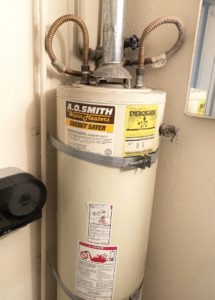
- Find the tank’s age. The manufacture date is coded in the serial number on the label. Many tank heaters last roughly 8–12 years.
- Listen for when it happens. Note whether it pops only while heating (sediment) or hisses constantly (call).
Don’t open the T&P valve to test it on an older tank, and don’t flush a tank that’s 10+ years old and has never been flushed without a plumber. Old drain valves can break or fail to close.
When to stop and call
Call a licensed technician if:
- Water is leaking from the tank or pooling at the base
- The T&P relief valve is releasing water or steam
- Hot water looks rusty or smells bad
- The popping comes with little or no hot water
- The tank is older and the noise is getting louder
If you smell gas (rotten eggs) near a gas water heater or anywhere in the home: leave the house, then call the gas company or 911. Don’t flip switches, light anything or use your phone until you’re outside.
If water is spreading: shut off the water at the fixture’s valve or the home’s main shutoff, and stay away from outlets, cords and the electrical panel if water is near them.
How to prevent it next time
- Flush the tank about once a year, more often with hard water. Follow the maker’s manual, or have a plumber do it during a visit.
- Keep the thermostat around 120°F.
- Ask about the anode rod on tanks a few years old. It protects the tank from corrosion and wears out over time.
- Consider filtration if scale is a constant problem in your home. See whole-house water filtration.
What a Henley’s technician checks
Tank age and condition, sediment level, the burner or elements, the T&P valve, venting on gas units, and signs of corrosion. You get honest options: flush, repair, or replace if it’s truly at the end of its life.
Henley’s has been family-owned since 1983. Bryan Henley started it, and owner Billy Henley runs it today. We still do the trade the way it’s supposed to be done: an honest diagnosis, no upsell pressure, the aim of fixing it right the first time, and treating your home like it’s ours.
Neighbors have left 300+ Google reviews for our Corona location. Licensed local technicians, CA Lic. #776658, serving Riverside, San Bernardino and Orange counties.
Call (909) 883-8827 or request service. Plumbing estimates are free. Want to know what’s in your water? Henley’s offers a free in-home water test. Request it here (choose “Free in-home water test” on the form).
¿Prefiere español? Llame al (909) 883-8827 y pida hablar en español. Prefer Spanish? Ask when you call, and we’ll get someone who speaks Spanish on the line.
Related: Water heaters | Repair or replace your water heater? | How long should a water heater last? | Water heater leaking from the bottom | No hot water?
Serving Riverside, San Bernardino and Orange counties. Riverside County: Corona, Riverside, Norco, Eastvale, Jurupa Valley, Moreno Valley, Calimesa. San Bernardino County: San Bernardino, Fontana, Rancho Cucamonga, Ontario, Redlands, Rialto, Upland, Chino. Orange County: Yorba Linda, Orange, Fullerton, Placentia.
Frequently asked questions
Why is my water heater making a popping noise?
A popping or rumbling water heater is almost always sediment. Minerals from hard water settle on the bottom of the tank, and water trapped under that layer boils and pops when the burner or element heats it. It isn’t an emergency by itself, but it wastes energy and wears the tank out faster. A flush often helps, and an older tank that pops and leaks is usually ready to replace.
Is it safe to wait?
Usually yes, for a short time, since sediment popping isn’t an emergency. But it wastes energy and shortens the tank’s life. If it also leaks, makes rusty water, or the relief valve is releasing water, call soon.
Is a popping water heater dangerous?
Usually not by itself. It’s normally sediment. It becomes a concern if the tank leaks, the relief valve releases water, or you have little or no hot water. Then it should be checked.
How often should I flush my water heater?
About once a year is a common guideline for tank water heaters, and more often in hard-water areas like the Inland Empire. Always follow the manufacturer’s manual.
Will flushing stop the popping?
Often it reduces or stops it if the sediment hasn’t hardened too much. On older tanks with heavy buildup, flushing may not help much.
What does it cost to have Henley’s look at my water heater?
Plumbing estimates are free, and you get the price before any work begins.