If tonight’s forecast has you thinking about your pipes, do these four things before bed: unhook the garden hoses, cover the hose bibs, wrap the exposed pipe at the backflow preventer, and find your main shutoff so you are not hunting for it at 6 a.m. The rest of this guide explains why each one matters for frozen pipes in Redlands and what to do if a pipe freezes anyway.
Redlands is not the mountains, but clear, still winter nights can drop low enough here to leave frost on the lawn. Most indoor plumbing never notices. The pipes that do are the ones outside the walls: hose bibs, the backflow device on the irrigation line, and any copper that runs along a garage wall or through an unheated space.
Start where frozen pipes usually begin: the hose bibs
When we see frozen pipes in Redlands, the hose bib is the usual suspect. A hose left connected traps water in the faucet body. When that water freezes, it expands and can split the valve or the pipe just behind it, inside the wall. You often do not find out until spring, when you turn the faucet on and water runs into the stucco instead of out the spout.
- Disconnect every hose and drain it.
- Fit a foam faucet cover over each hose bib. They cost a few dollars at any hardware store.
- If a hose bib drips with the handle closed, have it repaired now. A slow drip outside freezes into a plug of ice right at the spout.
Protect the backflow preventer and irrigation line
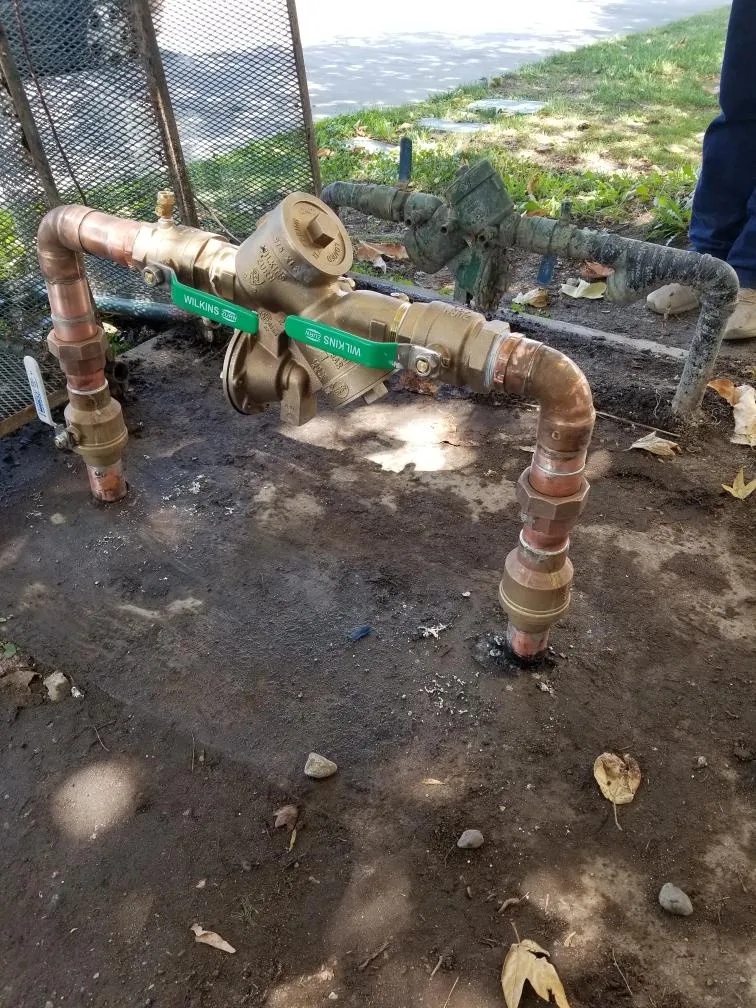
The backflow preventer is the brass assembly with two small valves that sits above ground where your sprinkler system tees off the house supply. Because it stands in open air with thin brass bodies and test cocks, it is one of the first things to crack in a hard frost.
- Wrap it with an insulated backflow cover or a thick old towel and a plastic bag over the top to keep it dry.
- If you will not water for the season, ask your landscaper or plumber how to shut and drain the irrigation side properly. Closing the wrong valve can leave water trapped in the device.
- Turn off automatic sprinkler cycles on freezing mornings. Water on sidewalks turns to ice, and a frozen valve can stick open.
Check pipes in the garage, attic and along outside walls
Walk the house and look for any water line you can see. Copper or PEX that runs along a garage wall, behind a water heater in an unheated closet, or across an attic is more exposed than the lines inside the living space.
- Slip foam pipe covers over exposed runs you can reach. Pay attention to elbows and valves.
- Keep the garage door closed on cold nights if the water heater or a laundry hookup is in there.
- On the coldest nights, open the cabinet doors under sinks on outside walls so warm room air reaches the pipes.
- A pencil-thin drip from the faucet farthest from the main shutoff keeps water moving. Save this for nights well below freezing; it is not needed every time it gets chilly.
The American Red Cross has a short guide on preventing and thawing frozen pipes that is worth bookmarking.
Know where your main shutoff is before you need it
When a pipe splits, the damage is measured in minutes. Most homes here have a main shutoff valve on the house side of the line, often near the front hose bib or where the water line enters the garage, plus the city-side valve in the meter box at the curb.
Find yours now, make sure the handle turns, and show everyone in the house where it is. If it is stuck or seized, that is a good repair to get done before winter. Our plumbing services cover shutoff valves, hose bibs and backflow repairs.
Valve stuck or hose bib dripping? Get it fixed before the next cold morning. Plumbing diagnosis and estimates are free, and repairs are 10% off with a $250 minimum repair. Call (909) 883-8827 or schedule online.
If a pipe freezes anyway
Signs of a frozen line: a faucet that gives a trickle or nothing at all on a cold morning, frost on the outside of a pipe, or a bulge in a section of copper.
- Leave the faucet open so melting water has somewhere to go.
- Warm the pipe gently with a hair dryer, a heating pad or warm towels, working from the faucet back toward the frozen spot.
- Never use a torch, a propane heater or an open flame. Besides the fire risk, a pipe heated too fast can burst.
- If you cannot find or reach the frozen section, or water does not return within about half an hour, call a plumber.
After the thaw: check for hidden damage
A pipe can crack while frozen and only leak once the ice melts. After a hard freeze, look at hose bibs, the backflow preventer and the garage lines for drips. Then check your water meter: turn off every fixture in the house and watch the meter’s leak indicator for a few minutes. If it moves, water is going somewhere.
A crack inside a wall or under the slab will not always show right away. Water stains, a warm spot on the floor or a running sound with everything off are worth a call; our leak detection service finds the source without opening more wall than needed. For other ways pipes fail, see the most common causes of a leaky pipe.
We work across Redlands and the nearby foothill communities. See our Redlands plumbing services for the full range of repairs we handle there.
Frequently asked questions
Should I drip my faucets on cold nights in Redlands?
Only on nights forecast well below freezing, and only the faucet farthest from your main shutoff, at a pencil-thin stream. On ordinary cold nights, covering hose bibs and the backflow preventer does more good.
Do I need to cover my backflow preventer in winter?
Yes. It sits above ground with thin brass parts and is one of the first pieces of plumbing to crack in a frost. An insulated cover or a towel with a plastic bag over it is enough on most nights.
How do I know if a pipe burst after it froze?
Look for drips or spraying water once the pipe thaws, wet stucco or drywall, or a water meter that keeps moving with every fixture off. If you see any of those, close the main shutoff and call a plumber.
Can I use a heat gun or torch to thaw a frozen pipe?
No. Open flames and high heat are a fire risk and can heat the pipe so fast it splits. Use a hair dryer, heating pad or warm towels, and keep the faucet open while you work.
Water where it should not be? Shut off the main, then call (909) 883-8827, or tell us what you are seeing and we will set up a visit.